Industry Collaboration


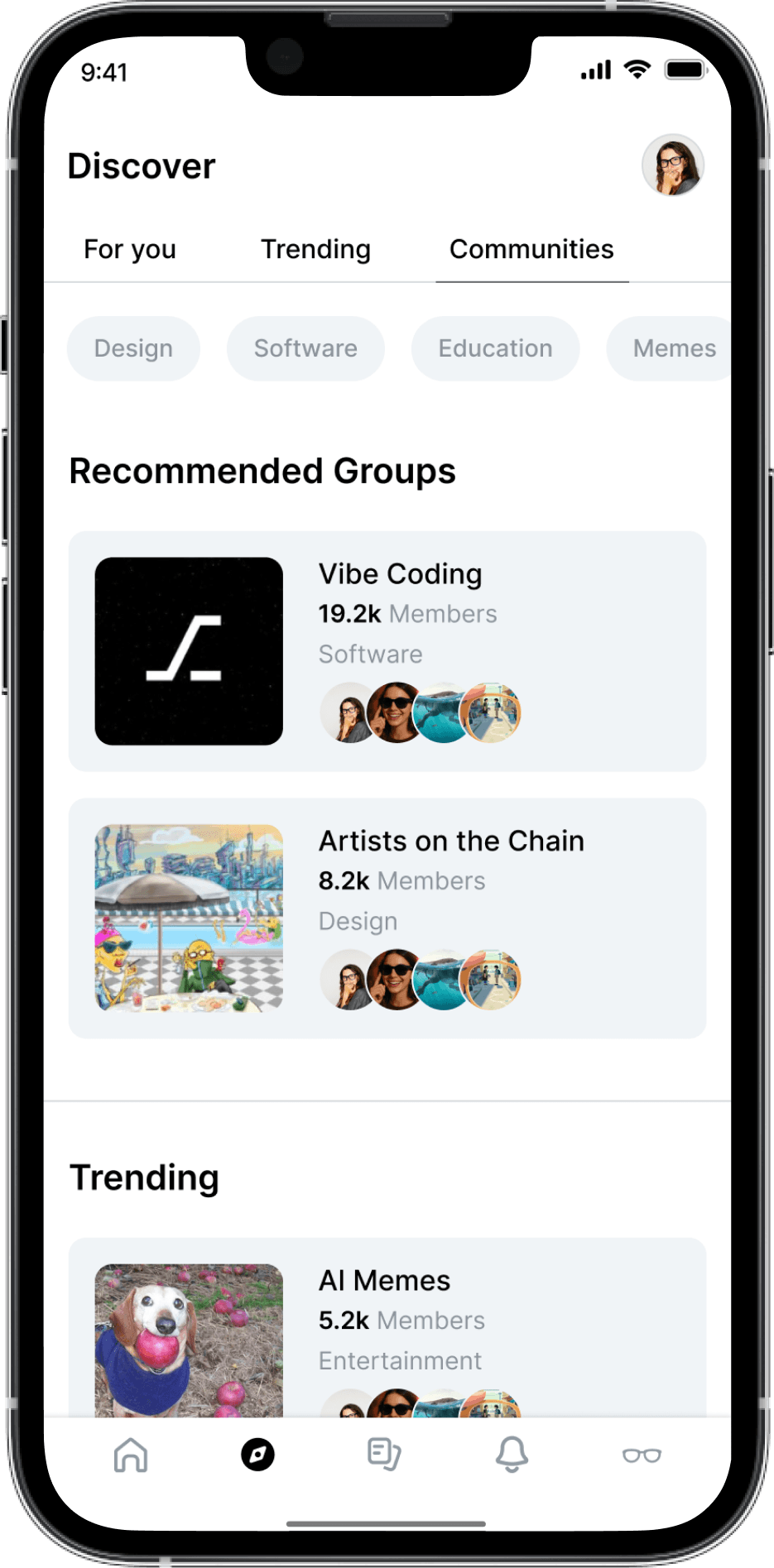
AI Add-Ons is a concept for giving Ray-Ban Meta glasses a personality of your choosing, built as three working examples and the platform to create your own: Wardrobe Wingman, Ghost Run Club, and Dare Roulette.
At a Glance
Role
Interaction Design Lead
Team
Meta × SCADpro
Duration
10+ weeks
Problem
Redefine how Gen Z connects in real time
Proof
Pitched AI Add-Ons to 20+ Meta stakeholders at Menlo Park HQ
In early 2025, Meta partnered with SCADpro, bringing on a team of 22 students, myself included, to help build toward its own mission: the future of human connection, and the technology that makes it possible. The Ray-Ban Meta glasses were strong technology, but they hadn't yet become part of how Gen Z actually connects with each other day to day.
The brief was specific: design low-friction, real-time social experiences Gen Z would actually use daily, built on the glasses' existing audio-first interface and the Meta app. Real constraints came attached from day one, too: no changes to the hardware, and a solution achievable within 18 to 24 months. This wasn't a concept exercise. It needed to be something Meta could realistically build.

Two screens, a thumbs down, and a laptop that couldn't decide if it was digital or analog.
My work on this project started with research: self-ethnography, interviews with friends, and online research, on top of structured focus groups and surveys, pulling in 150+ survey responses and 300+ insights from focus group sessions alone, totaling more than 5,000 data points.
I contributed across that data collection, but where I focused most was synthesis, turning all of it into affinity-mapped themes.
Key Insights
Public use came with real friction. Several participants described feeling self-conscious triggering voice commands like 'Hey Meta' around other people.
People wanted the AI itself to feel less robotic. A recurring wish across interviews was for a more natural, humanized interaction, not just a faster assistant.
Self-expression mattered more than expected, but the hardware itself was locked. With 71% seeing wearable tech as self-expression, that pushed personalization toward the experience layer instead of the product.
Belonging mattered as much as personalization. 76% said they only shared with their inner circle, treating connection as something built in small circles, not broadcast widely.
Across all of it, we landed on a three-tier hierarchy of what Gen Z actually wanted: for the glasses to fit seamlessly into everyday life, to create small moments of shared belonging, and to feel like a genuine extension of personal identity.
That wasn't a feature gap. It was a behavior gap. People didn't need the glasses to do more, they needed a way to use them that fit naturally into how they already moved through the world.
Once we knew this was a behavior problem, not a feature problem, we still had to work inside real limits on how we could respond.
Coordinating a team of 22 also meant deciding how to explore that many directions at once. We split into focused sub-teams so each could dig into a different angle in parallel, then bring what we found back together.

Our design team, mid-exploration and fully accessorized.
Every proposed feature got mapped against development time, novelty, and complexity, sorted into three tiers: immediately actionable, possibly feasible, and most ambitious. That framework shaped which ideas we pushed further and which we set aside early — the feature that would eventually become our flagship concept started out sitting in that most-ambitious tier.
Some limits showed up mid-process when someone from Meta stress-tested our concepts to try to break them. One gesture-based idea didn't hold up: recognizing custom gestures needed the camera running almost continuously, draining battery too fast to be practical.
Building a real, working AI backend wasn't realistic in this timeframe either, so we used Wizard-of-Oz prototyping: real LLM responses synced to sound cues timed to play through the glasses, letting us test genuine reactions before investing in infrastructure we didn't need yet. I planned and executed these rounds myself.

Rough, early, and exactly how you find out if something actually works.
Together, these constraints didn't close the door on ambition. They just made clear exactly where the real decisions needed to happen.
With those constraints in place, and after narrowing nearly 1,000 raw ideas down to about 80 real directions, a handful of decisions ended up shaping where the project actually went.
What we explored first
By the time we'd synthesized our research, our ideas had sorted into four real categories: Enhancing AI Interactions, Enhancing Capturing, Personalized Experiences, and Memory Sharing.
Each held a cluster of genuinely different directions: personalized AI tone and onboarding, smarter capture tools like vibe-aware shutter feedback, a "catch me up" mode for reconnecting after time away, shared albums that synced automatically between everyone at a hangout.
Buried inside Personalized Experiences was a single line that would end up mattering more than anyone realized at the time: "Add-ons for unique AI use cases (specific games, meditation, etc.)" It was one bullet point among dozens. Nobody flagged it as the idea yet.
The Framework
To choose a direction we could actually defend, not just the idea the room liked best, we built a three-part framework: Feasibility, Relevance, and Vision. Every serious direction got weighed against all three. It's what let us walk Meta's team through our reasoning and hold up under real scrutiny later, not just present a concept we liked.

Feasibility, relevance, vision: the lens we ran every real idea through before we let ourselves fall for one.
I helped lay out this framework with my team, the three-axis structure we'd use to pressure-test every idea on the board before we let ourselves fall in love with one.
The convergence moment
The actual decision didn't happen through further ranking or voting. It happened live, in a whiteboard session.
Looking at everything scattered across our four categories, the deeper capture tools, the personalized modes, the shared-memory features, that one small "add-ons" bullet, something clicked for me: these weren't four competing directions. They were pieces of the same idea.
If the glasses could support downloadable, swappable AI behaviors, "add-ons," then capture, personalization, and memory weren't separate features to choose between. They were just different Add-Ons of the same underlying system.
I put that into words first, in that room. It's a moment I'm genuinely proud of: the reframe the whole rest of the project ended up building around.
The decision: ai add-ons

Before there was a name for any of this, there was just a lot of paper and a lot of ideas.
The concept we landed on was AI Add-Ons: downloadable, community-made "expansion packs" that transform what your AI can do, whether that's acting as a pacer for your daily run or a chaotic party host for your group chat.
Each Add-On is a context-aware, voice-enabled upgrade layered onto the glasses' existing AI. Not new hardware. Not a new app. A new behavior.
We built three examples to prove the concept could stretch across real, different use cases, mapped onto the three types of social connection our research had already surfaced:

Wardrobe Wingman (Person + AI): a style-savvy companion that plans outfits around weather, your calendar, and your mood, identifies pieces you spot in the wild and finds where to buy them, and turns getting dressed into a quick back-and-forth instead of a solo guessing game.

Ghost Run Club (Person + Digital): a voice-controlled running companion that turns solo jogs into something competitive and alive: real-time pace battles against your own best time or a friend's "ghost" run from yesterday, hands-free control, and built-in moments worth posting.
Dare Roulette (Person + Person): an AI party host that throws out real-time dares instead of asking for them, tuned to keep a group's energy up IRL or over video, with its own leaderboard and reaction capture built in.
Three Add-Ons, three completely different use cases, one unifying system underneath all of them.
Platform Over Polish
Rather than keep refining those three examples in isolation, we chose to build out the full system they'd need to actually exist.
Creator Flow is a conversational way for anyone to build their own Add-On just by describing it to Meta AI, which shapes it into a name, icon, and personality and publishes it straight to a Marketplace. Community is a feed for discovering what other people were building, remixing, and sharing.
A platform story mattered more at this stage than perfecting any single Add-On alone. The three examples were proof of what was possible, not the whole product.
Feedback before Final
Before we ever reached the final presentation, we walked the concept, the three examples, the Marketplace, and Community past Meta's own team directly, and got back real, specific, individual feedback.
I was in the room for several of these conversations myself, presenting alongside my team rather than hearing the reactions secondhand.
Meta's Platform Purist loved the Marketplace and the UI clarity, then pushed us further: "This can't just be three cool examples. I need the whole platform, how Community actually works, what happens to content when someone takes their glasses off."
Meta's Personality Advocate backed the framework and the AI's tone immediately, then raised the bar: "Let people shape its personality. Give them a creator journey, not just a download."
Meta's Feasibility Checker confirmed the technical bones held up, and admitted Ghost Run Club was a personal favorite: "Just get specific with me. Real system prompts, real sensor requirements. Not just vibes."
None of these decisions were free. Choosing one direction, and one system underneath it, meant walking away from three categories' worth of other real ideas.
Three Add-Ons had to go from a concept to something people could actually react to, plus the platform that would hold all of them together. I was hands-on across the build: contributing screen designs, fleshing out feature-level detail for each Add-On, and building templates the rest of the team designed from.
Designing the Add-Ons
Each Add-On's one-line pitch had to become an actual feature set before it could become a screen. As interaction design lead, I had my team and I work through what each one would actually do, moment to moment.
Wardrobe Wingman: outfit planning that factors in weather, your calendar, and your mood; a conversational style advisor you could actually argue with about your vintage denim; a reverse fashion look-up that could spot something on a stranger and find where to buy it; instant shopping links that skipped the scrolling spiral entirely.
Ghost Run Club: voice-controlled start and stop so you're never fumbling with your phone mid-run; gamified motivation with pace nudges and light trash talk; real-time pace battles against your own best time or a friend's "ghost" run from the day before; post-run brag moments designed to make sharing your finish feel as good as crossing it.
Dare Roulette: an AI dare generator tuned to the room's vibe; cue-the-moment signals, audio paired with light indicators on the glasses themselves, that dare you to move; a "party host" personality that acted half game-master and half instigator; multi-POV reaction capture to catch everyone's best (and worst) faces; leaderboards to keep the whole thing competitive.


Wardrobe Wingman, Ghost Run Club, Dare Roulette: three completely different vibes, one shared system underneath.
I contributed screen designs across all three concepts, and built reusable templates the rest of the team could design from. The glasses themselves have no display, everything visual lived in the companion app, while the glasses stayed within their real hardware: audio, photo and video capture, and on-device voice interaction. Designing across that split, what the app shows versus what the glasses handle through sound and camera alone, was its own real constraint.
Building the platform
The Marketplace went through a real shift in the middle of our process. It started as a browse-and-filter experience in the app, built purely for discovery. My team and I evolved it by adding a quick-create icon and a "Create Your Own Add-On" prompt, so the page stopped being purely explorative and started inviting creation too.


Browse, discover, download: the platform that made three Add-Ons feel like it could be hundreds.
Before AI Add-Ons ever reached a stage, it had already been tested and validated. Everything that followed, the performance, the demo, the trip to Menlo Park, was built on evidence we'd already gathered, not just confidence.
Usability testing
0
%
Expressed strong interest
0
%
Said it would shape their decision
In structured usability testing, AI Add-Ons landed well past a passing grade. 80% expressed strong interest, and 70% said the concept would genuinely shape how they'd think about the product.

Where 80% and 70% actually came from.
The Final Presentation
With that validation in hand, we took AI Add-Ons to the Final Presentation, not as a slide deck walkthrough but as a fully written and staged scene on a custom soundstage. I served as the driving narrator, guiding the story while the rest of the team acted out how Wardrobe Wingman, Ghost Run Club, and Dare Roulette would actually play out in someone's day, demonstration and explanation woven directly into the performance itself.
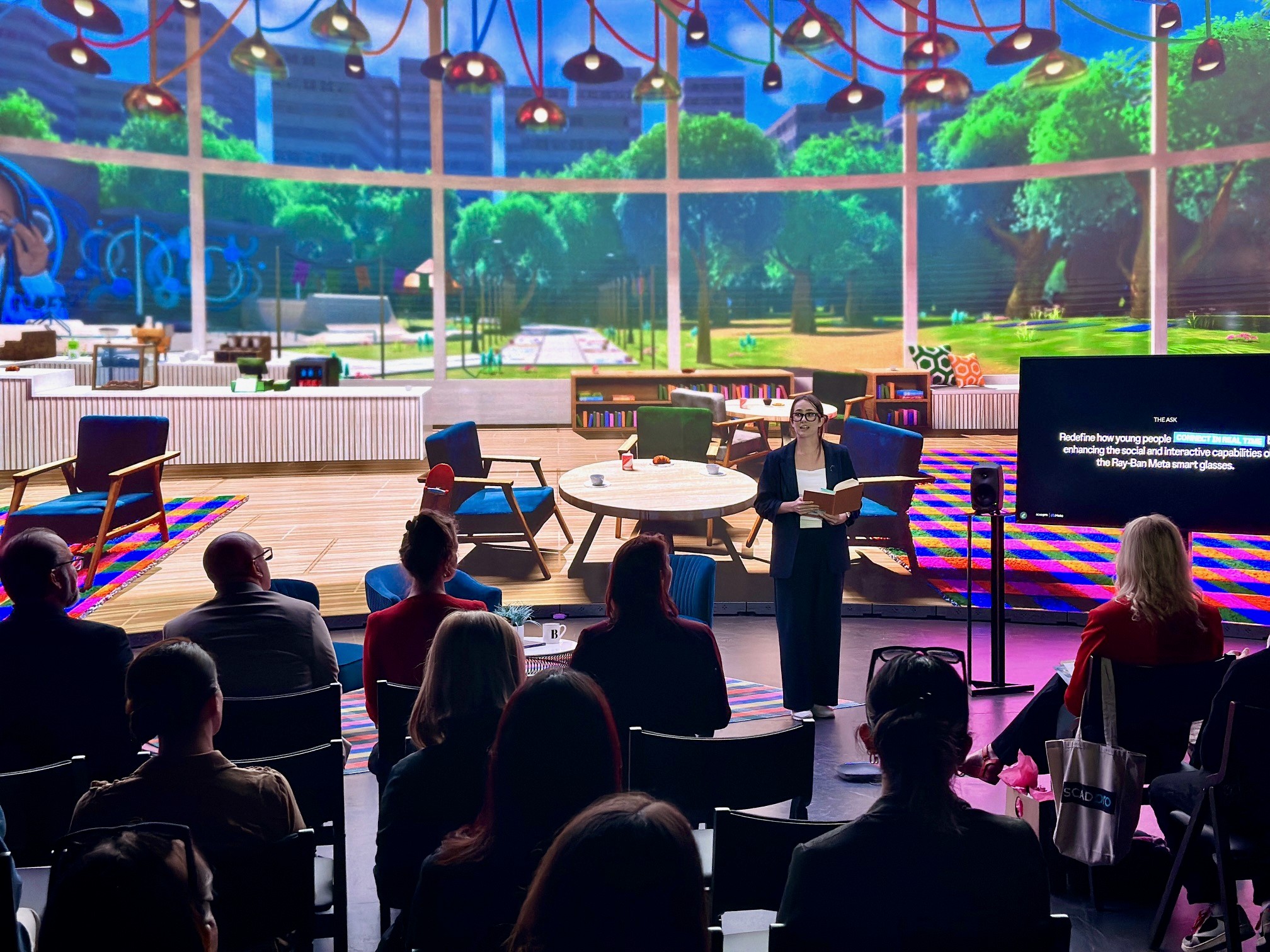
This is what 'driving narrator' actually looked like.
Alongside the performance, we built out a full set of production assets to make the concept feel real: a working prototype, a full UI file, a produced commercial, individual demo videos for each Add-On, a complete process book, and a project website.
After the performance, we ran a full live demo walkthrough for Meta's team, letting them experience the Marketplace, Creator Flow, and Community hands-on instead of just watching it happen.
Client feedback
Meta's team was overall very pleased with the presentation. They praised the depth and clarity of the user journeys and flows, and said they appreciated that we'd fully committed to developing AI Add-Ons instead of spreading ourselves across competing ideas.
They were also impressed that we'd kept the concept current with real changes to the Meta View app as the project went on. They asked how AI Add-Ons could be rolled out gradually, specifically through a minimum viable product, and what a realistic release timeline might look like.
Part of the team also presented a UI demo that Meta's team called out as particularly impressive.
Menlo Park
That reception carried all the way to Meta HQ. Out of all 22 of us, my team nominated me as one of just 5 students chosen to represent our work at Menlo Park, presenting to more than 30 stakeholders across product, design, and engineering, a very different audience than the mentors and creatives we'd been presenting to all along.
I was flown out to California, and built and delivered that pitch alongside the four other students chosen, reframing AI Add-Ons around feasibility and business impact instead of pure concept, so a product team could see it as something they could actually act on, not just admire.
The response was overwhelmingly positive. What started as a classroom brief ended with our concept taken seriously as a real product direction, by the company that inspired it in the first place.

Ten weeks in a classroom led here.

Same story. A very different room.

Even the hallway had a photo op!
None of it would have landed without the full team behind it, all 22 of us, three thousand miles from where we'd started.
Standing in front of more than 30 people from Meta's product, design, and engineering teams at their headquarters, I found myself thinking about how far this had come from where we started. I've done a lot of SCADpro collaborations, but I'd never gotten to carry something this far before. I didn't expect an idea that started so open-ended, a single bullet point buried in a list of dozens, to end up shaping a real conversation with the people who'd actually decide whether to build it. I especially didn't expect that the words I put into that whiteboard room, the ones that first called it AI Add-Ons, would be the ones that ended up carrying the whole project forward.
What I'm proudest of isn't the trip itself. It's what it represented. My peers nominated me to be one of five people who got to represent our work at Meta HQ, and once there, I helped build and deliver that pitch myself alongside the four other students chosen. That wasn't just a nice moment, it was proof that my voice had actually shaped the work, not just supported it from the sidelines. Having that reflected back by people who watched me do it firsthand meant more to me than any single deliverable ever could. That confidence has stayed with me since. I trust my own opinions more now, even the strong ones, because I've seen what happens when I actually put them forward.
None of this happened alone. Twenty-one other genuinely talented people built this with me, each bringing something I couldn't have on my own. I'm grateful SCADpro and Meta trusted a room full of students with something this real, and that trust still means a lot to me.

Every one of the twenty-two, in one frame.
Tools & Skills
Interaction Design
UX Research
Figma
Cross-Functional Collaboration
Storytelling & Presentation
Wizard-of-Oz Prototyping
Deeper Look
More on how a team of 22 actually pulled this off. The details behind the details.
In the meantime, here's more to look through: the deck Meta approved for public sharing, and the full process book if you want the whole story.
This is one story. There are others worth reading.









Behind the Portfolio
AI-Assissted Design
Rebuilt my own portfolio with AI as a real collaborator, turning 9+ wireframe rounds and thousands of logged decisions into a fully documented system.


Equity by Design
Independent research
Crafted a UX framework translating feminist theory into practice, validated with 10 UX practitioners and built out as a full interactive site.