Industry Collaboration


At a Glance
Role
Interaction Design Lead
Team
Meta × SCADpro
Duration
10+ weeks
Problem
Redefine how Gen Z connects in real time
Proof
Earned an encore to 20+ Meta stakeholders
In early 2025, Meta partnered with SCADpro, bringing on a team of 22 students, myself included, to help build toward its own mission: the future of human connection, and the technology that makes it possible. The Ray-Ban Meta glasses were strong technology, but they hadn't yet become part of how Gen Z actually connects with each other day to day.
The brief came with real constraints already attached: no changes to the hardware, and a solution achievable within 18 to 24 months. This wasn't a concept exercise. It needed to be something Meta could realistically build.
A few details in this project are under NDA. If you're curious what's behind the redactions, ask me. :)

Two screens, a thumbs down, and a laptop that couldn't decide if it was digital or analog.
My work on this project started with research: self-ethnography, interviews with friends, and online research, on top of structured focus groups and surveys, pulling in 150+ survey responses and 300+ insights from focus group sessions alone, totaling more than 5,000 data points.
I contributed across that data collection, but where I focused most was synthesis, turning all of it into affinity-mapped themes.
Key Insights
Public use came with real friction. Several participants described feeling self-conscious triggering voice commands like 'Hey Meta' around other people.
People wanted the AI itself to feel less robotic. A recurring wish across interviews was for a more natural, humanized interaction, not just a faster assistant.
Self-expression mattered more than expected, but the hardware itself was locked. With 71% seeing wearable tech as self-expression, that pushed personalization toward the experience layer instead of the product.
Belonging mattered as much as personalization. 76% said they only shared with their inner circle, treating connection as something built in small circles, not broadcast widely.
Across all of it, we landed on a three-tier hierarchy of what Gen Z actually wanted: for the glasses to fit seamlessly into everyday life, to create small moments of shared belonging, and to feel like a genuine extension of personal identity.
That wasn't a feature gap. It was a behavior gap. People didn't need the glasses to do more, they needed a way to use them that fit naturally into how they already moved through the world.
Once we knew this was a behavior problem, not a feature problem, we still had to work inside real limits on how we could respond.
Coordinating a team of 22 also meant deciding how to explore that many directions at once. We split into focused sub-teams so each could dig into a different angle in parallel, then bring what we found back together.

Our design team, mid-exploration and fully accessorized.
Every proposed feature got mapped against development time, novelty, and complexity, sorted into three tiers: immediately actionable, possibly feasible, and most ambitious. That framework shaped which ideas we pushed further and which we set aside early.
Some limits showed up mid-process when someone from Meta stress-tested our concepts to try to break them. One gesture-based idea didn't hold up: recognizing custom gestures needed the camera running almost continuously, draining battery too fast to be practical.
Building a real, working AI backend wasn't realistic in this timeframe either, so we used Wizard-of-Oz prototyping: real LLM responses synced to sound cues timed to play through the glasses, letting us test genuine reactions.

Rough, early, and exactly how you find out if something actually works.
Together, these constraints didn't close the door on ambition. They just made clear exactly where the real decisions needed to happen.

Not the final version. Just the moment it started making sense.
With those constraints in place, and after narrowing nearly 1,000 raw ideas down to about 80 real directions, a handful of decisions ended up shaping where the project actually went.
None of these decisions were free. Choosing one direction meant walking away from others that were just as real.
For the final presentation, we wrote and staged a fully performed scene on a custom soundstage, not a slide deck walkthrough. I served as the driving narrator, guiding the story while the rest of the team acted out how the experience would actually play out in someone's day, demonstrations and explanation woven directly into the performance itself.
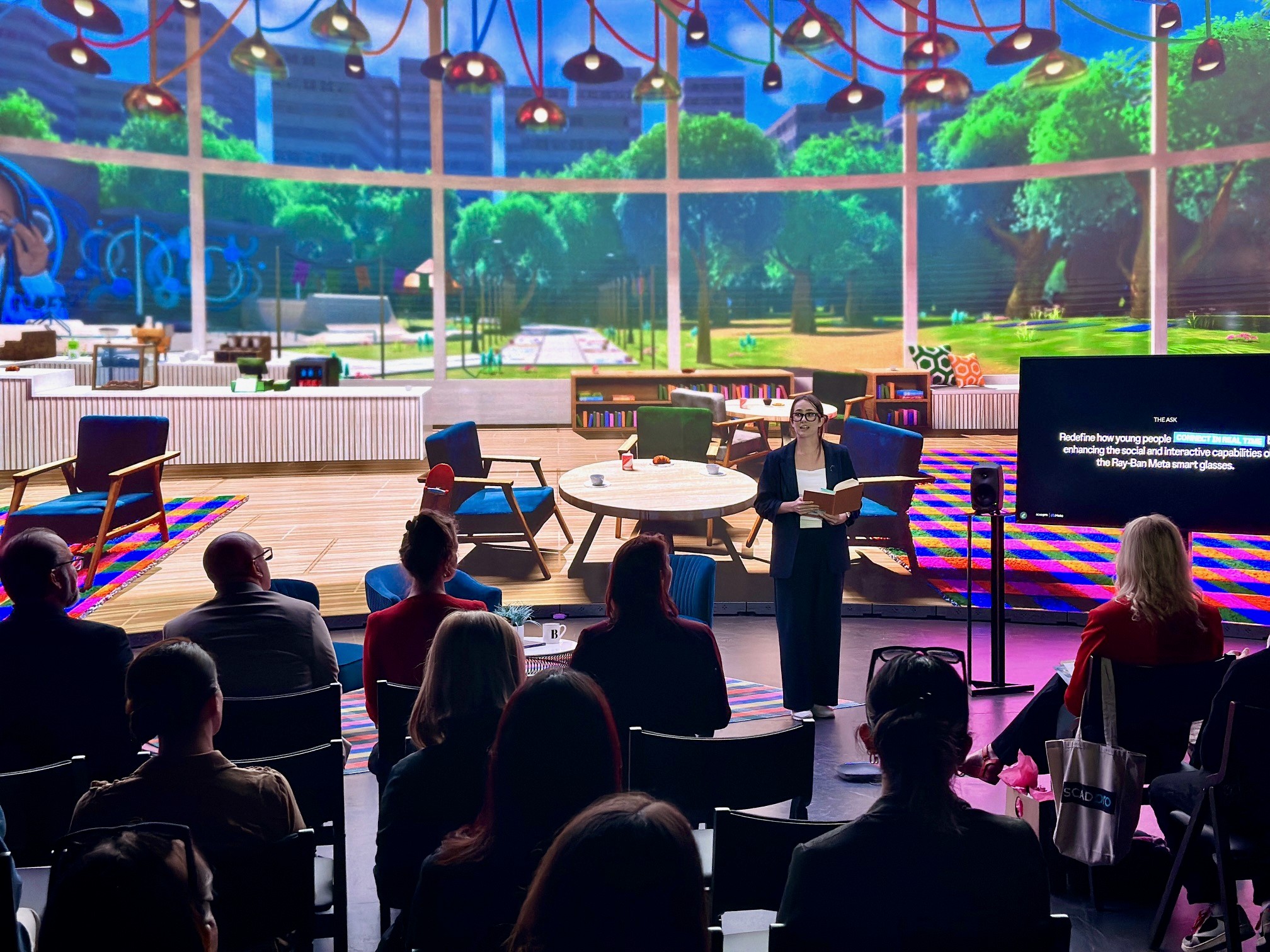
This is what 'driving narrator' actually looked like.
Alongside that, we built a working prototype, a full UI file, a produced commercial, individual demo videos for each concept, a complete process book, and a project website.

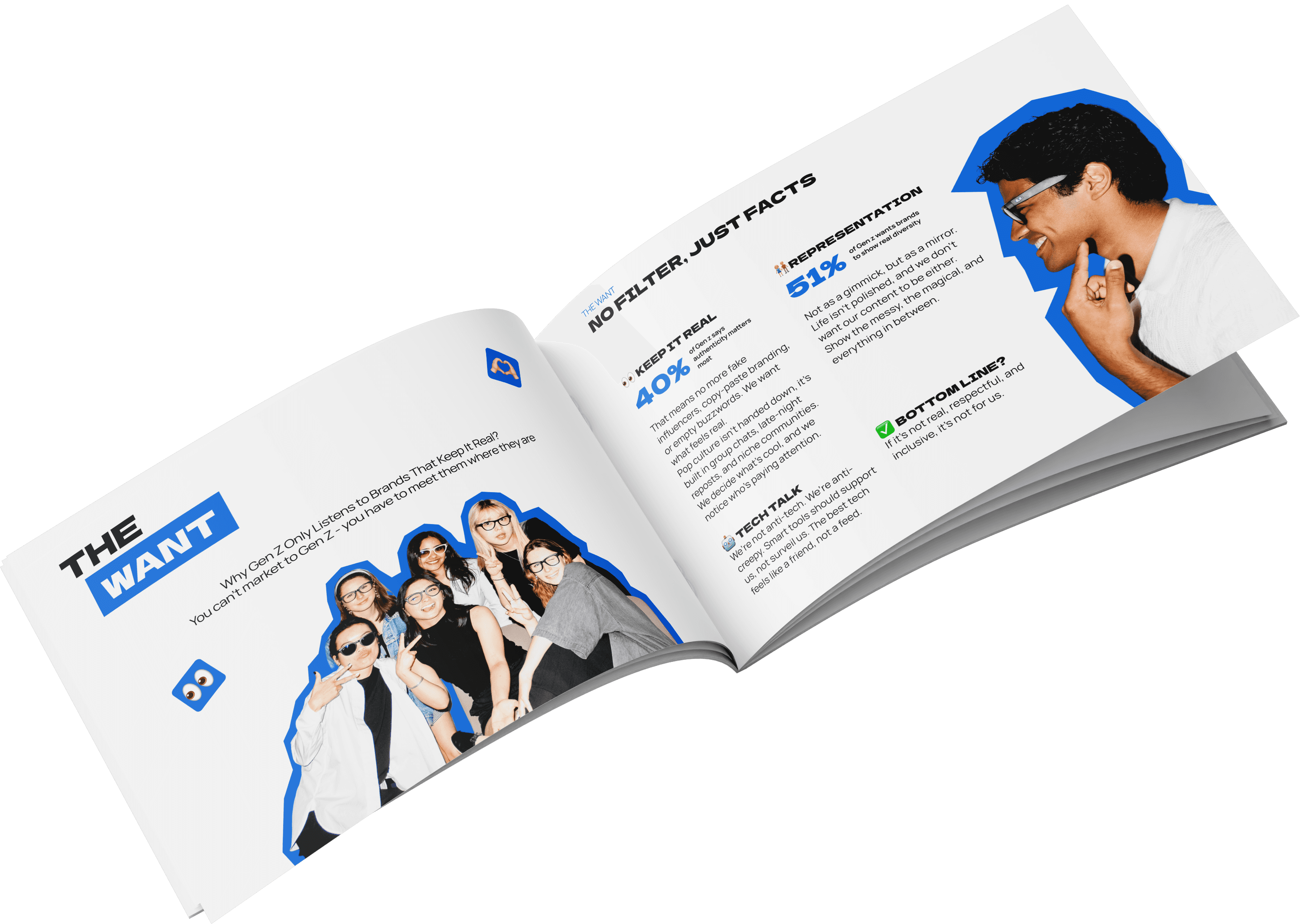
After the performance, we ran a full live demo walkthrough for the Meta team, letting them experience it hands-on instead of just watching it happen.
None of that was optional polish. It was what it took to make the idea land as something real, not just something proposed.
Everything shown on that stage had already been tested and proven out before it ever got there.
0
%
Expressed strong interest
0
%
Said it would shape their decision
That reception carried all the way to Meta HQ. I was one of a few people nominated from my team to travel to Menlo Park and present to more than 20 stakeholders across product, design, and engineering, a very different audience than the mentors and creatives we'd been presenting to all along. We rebuilt the pitch around feasibility and business impact instead of pure concept, framing the idea as something a product team could actually act on, not just admire.
The response was overwhelmingly positive. What started as a classroom brief ended with our concept taken seriously as a real product direction, by the company that inspired it in the first place.

Ten weeks in a classroom led here.

Same story. A very different room.

Even the hallway had a photo op!
None of it would have landed without the full team behind it, all 22 of us, three thousand miles from where we'd started.
Standing in front of more than 20 people from Meta's product, design, and engineering teams at their headquarters, I found myself thinking about how far this had come from where we started. I've done a lot of SCADpro collaborations, but I'd never gotten to carry something this far before. I didn't expect an idea that started so open-ended to end up shaping a real conversation with the people who'd actually decide whether to build it, or that my own voice would end up mattering as much as it did along the way.
What I'm proudest of isn't the trip itself. It's what it represented. My peers nominated me to be one of five people who got to present at Meta HQ. That wasn't just a nice moment, it was proof that my voice had actually shaped the work, not just supported it from the sidelines. Having that reflected back by people who watched me do it firsthand meant more to me than any single deliverable ever could. That confidence has stayed with me since. I trust my own opinions more now, even the strong ones, because I've seen what happens when I actually put them forward.
None of this happened alone. Twenty-one other genuinely talented people built this with me, each bringing something I couldn't have on my own. I'm grateful SCADpro and Meta trusted a room full of students with something this real, and that trust still means a lot to me.

Every one of the twenty-two, in one frame.
Tools & Skills
Interaction Design
UX Research
Figma
Cross-Functional Collaboration
Storytelling & Presentation
Wizard-of-Oz Prototyping
Deeper Look
More on how a team of 22 actually pulled this off. The details behind the details.
In the meantime, here's a sneak peek: the deck Meta approved for public sharing.
This is one story. There are others worth reading.


Equity by Design
Independent research
Crafted a UX framework translating feminist theory into practice, validated with 10 UX practitioners and built out as a full interactive site.